







15
Historically preserved mansion gets eclectic makeover
A true mansion, originally from 1922, with preserved architecture and full of details that reveal a rare magnificence, is the headquarters of the 22nd Edition of Casa Cor Rio de Janeiro, Brazil. With very high ceilings and large windows, the beautiful and famous building has been designed in an eclectic style with over 5,400 square meters of constructed area, divided into 52 environments, with about 80 professionals that have demonstrated that it is possible to renew with style, but without deleting the marks of time. The building was once a Boarding School of Nursing Anna Nery (1926 – 1973) and the College Student House (1973 – 1995). Here, past, present and future coexist in harmony. Enjoy the amazing photos of interior design and architecture!
The hotel’s lounge is a a 130 square meters balanced composition between pieces of diverse styles by architect Gisele Taranto. Imperfections were left on the floor, walls and frames as a way to rescue the memory of the mansion. The space also gathers pieces of art selected by curator Mara Fainziliber. Maneco Quinderé did the lighting.
The ceiling received a new structure made of corten steel and polycarbonate below the existing one, creating a semi-transparent layer that allows a partial view of it in its real condition.
Gisele also created a “book wall”, using books as bricks to complete part of a missing wall, making reference to the works of the german Hubertus Gojowczyk.
Lobby/reception. Hot pink walls contrast with the old, original elements of the property, in the environment of architect Pedro Paranaguá. Italian sofa, fitted with low modules and loose, reaffirm the contemporary twist. The Wave of Italian lamp Foscarini, bring movement to the high ceiling, with apparent frame. With organic form, the sculpture of Gabriela Maciel finished off the decor.
SPA Deca. The Tunisian marble floor tilts and turns into a ramp where they were carved lounge chairs and a niche for candles and books. Creativity excelled in architect Miguel Pinto Guimarães Playbook. He also designed a concrete Pergola which looks like a lace, in partnership with the artist Fabian Benicio. Among the decorative objects, Italian pads Lisa Corti and Alice Felzenszwalb ceramics give touches of color along the vertical wall landscaping. Italian lamps Tolomeo, on the sides, focus only the essentials.

Designer’s Studio. The mix between rustic and luxurious materials is the keynote of this space, a loft built by the architects Gabriela Eloy and Carolina Travaglini (1883–1961) for a young woman tied to the universe of fashion.
Jewelry. Divided into lounge and area, the space of Interior designers Mariana Dean, Jason Sartori and Luciana Arnaud pays homage to the fashion designer Coco Chanel and makes reference to her collection of jewelry. Crystal pendant refers to the retro atmosphere that permeates the atmosphere.
Loft + River. The architect Luiz Fernando Grabowsky idealized a space with a mixture of lounge, and office suite, based on a sophisticated and versatile dweller. The stacking bookcase modules of different sizes and finishes (mimics the wood), in the background, and the shiny lacquer orange and navy blue.
Kitchen. Orange and off-white were the choices of architects Lia Lamego and Fernanda Mancini to color the four corners of the kitchen. The project design was based on practicality. Porcelain flooring rustic texture coating won, in contrast to the softness of the glass countertop, in the same tone. A cutout in the ceiling gives lighting.
Reading room. The soft sofa by Sergio Rodrigues, is paired with the model of straight lines created by Lena Machado. They make up the elegant living drafted by the duo of architects Cristina Bezamat and Laura Bezamat.
Interactive room. Reuse was the watchword for Tiana Meggiolaro and Bia Lynch who set up the room with brick walls left exposed. “Based on the concept of upcycling and demos new function was given to the pallets, wooden structures used in freight transport that became bookshelf and countertop,” says Tiana.
Public bathroom. A dress with promotional stickers on the door leaves no doubt: the space is for women. But the architect was Adenowo Ketlein plus and extra effort in other women: walls with paper printed with rose petals and a showy red bench. In lighting, the trough with cold light, clipped on the ceiling, help in the retouching of makeup.
Foyer of Brigadier. As they could not interfere in the architecture of the house, architects Carolina Ladder and Patricia Landau created a Pergola of iron blue that announces the entrance to the shop of Brigadier. Attached to this structure, is a canvas blue pendant armchair. To taste the sweets of Fabiana D ‘ Ângelo, round wooden tables surrounded by classical Platner chairs were lined with citrus-green tone twill.
5
Modern dwelling merges with nature: Casa Itu
Situated about an hour from São Paulo, Brazil, Casa Itu has been designed by architecture firm Studio Arthur Casas as a refuge for a young couple with children. A prime position on the banks of a small lake and the presence of a large yellow Ipe tree has led the architects to create a house that takes maximum advantage of the landscape.
The floor plan is an L shape which divides the house in a simple way: the main volume contains the children´s room in the ground floor, a courtyard next to the home theater forms an intimate living room, a large living room opens onto the terrace and garden, erasing the boundaries between inside and outside. Above this volume are situated the master suite and a
gym. In the secondary volume are the dining room, kitchen and the service areas. On the first floor of this volume are the guest rooms.
The house is marked by horizontality and fluidity between the spaces. The entry is made at the point where the two volumes converge; a low-ceiling guides the look to the external landscape. On one side the stone floor of the dining room goes towards the terrace, gradually merging into the garden.
The living room is at a slightly lower level and has a higher ceiling. A tree trunk dominates this space, covering the single column present in the room. The windows slide completely and are hidden inside the walls, bringing the terrace and landscape into the house.
The wood floor and ceiling give a warm and domestic aspect to that space that is merged with nature. A second terrace room was created under the pergola in continuity with the living room.
The old Yellow Ipe tree was preserved and merges with the architecture; a staircase was created aligned with that tree to connect the deck with the first floor. Several pathways are possible between inside and outside, being one of the most strong characteristics of the plan.
The whole side of the volume is dominated by a large wooden deck and a swimming lane, integrated with the landscape by rocks that penetrate the pool.
Covered in cumaru wood and painted with a color that uses the local earth, even though it contains a large volume the house holds a discrete insertion in the landscape, its strong horizontality in dialogue with the tree canopies that surround the site.
4
Brazilian modernism: V4 House by Studio MK27
With each new project contemporary architecture is forced to optimize spaces and use the maximum of each square meter of the site. V4 House, designed by Studio MK27 is a rare anti-example. Its occupation of the land is very far from the maximum coefficient. Laws allow for much larger constructions. The solution adopted, however, dialogues with the dimension of the site, formulating an adequate relation between the scale of the construction and the site. Contrary to the surrounding houses, a garden neighborhood of São Paulo, Brazil, V4 House is a ground floor and almost disappears when seen from the street.
The living room, positioned at the front of the house, is under a delicate beam of exposed concrete. Two rows of door frames, on both sides of the living room, can be completely retracted, constituting total integration between the front garden, the living room and the back patio. The living room, in this case, shelters from rain and sun, like a large veranda. And, under the beam, in one of the extremities, there is an open kitchen. On the ceiling of this volume, a large deck is an empty space that functions as a solarium. This terrace makes almost the entire project like a garden.
The concrete beam appearing from the wooden box, houses the two rooms that face the patio. In the wooden box from where the concrete beam appears, are the two rooms that face the patio.
The wooded shaded area enables to control the inner temperature and, simultaneously, offers privacy to the environments.
The bathroom of the master bathroom faces a small garden, removed from the rest of the house.
The program for the client’s needs and the dimensions of the site made it possible to do an unusual project: an urban ground-floor house. The house ends up, therefore, being very delicately inserted with the surroundings.
Photos: Courtesy of Studio MK27
18
Geometric concrete dwelling emerges in Sao Paulo
Nestled in the urban city of Sao Paulo, Brazil, Maracanã House is a breath of fresh air designed by architecture studio Terra e Tuma Arquitetos Associados. This 1,991 square foot (185 square meters) contemporary home has a unique geometry, opaque in grayish materiality, clear in glass surfaces or vibrant on the access mural, showcasing its presence like a new event around the bucolic surroundings, where curious people wonder about this new construction. Its discordant geometry in relation to the traditional houses of the neighborhood surprises upon the moment of arrival.
More than a space, its levels gradually form a path through which outside and inside merge in a proper and continuous shape. The house discovers new possibilities to the limitations of the scanty plot, whose complexity exceeds horizontal and vertical routes which invariably leads to a new spacial experience, capable to reveal singularities of the district’s geography.
“Entering the house doesn’t mean to set apart the city, which leads us to it or to close off a disconnected universe. Its access has to be discovered from behind the ceramics mural painted in black, white and red compositions. Entering the house means, simply to transpose a succession of spaces, now narrow, now lightened, now shady, which leads us always to new experiences.”
“The house’s arrival happens from the emptiness, which is a viewpoint to the living space and also an identification area of its functional sections: social and services below, intimate above. Like the city streets, the lights between their spaces enlighten in every direction, through big glass openings which sets against the solidity of the concrete materiality which it is built.”
Photos: Pedro Kok
14
Bold and colorful 65 square meters flat in São Paulo
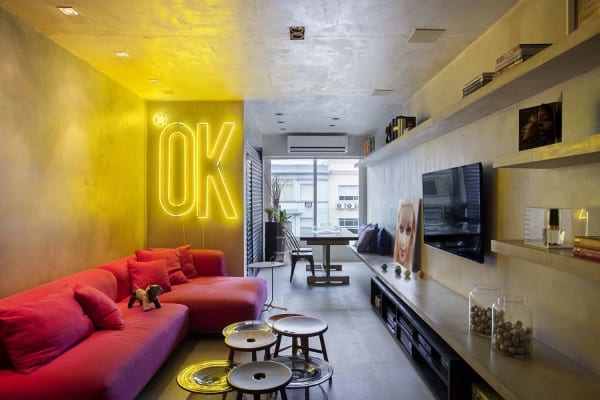
This ultra-funky apartment in Sao Paulo, Brazil is chalk full of color which helps to make everything seem so much larger. Spotted on Casa, this small living space is only 700 square feet (65 square meters) but with an abundance of light and color, the home feels spacious and cozy. This combination is the big hit of this interior project, which was carried out by the architect and designer Adriana Yazbek. The apartment was originally compartmentalized, which made the rooms dark and unlivable. Adriana opened one of the two rooms and joined to the living room, organizing the office. The door was taken out of the bedroom and exchanged with a curtain to add privacy and separate the space. The flooring was replaced with wood in the dry areas and blue cement in the kitchen and colorful tiling in the bathroom.
Photos: Marco Antonio
29
Contemporary Loft in Itaim presenting stunning details
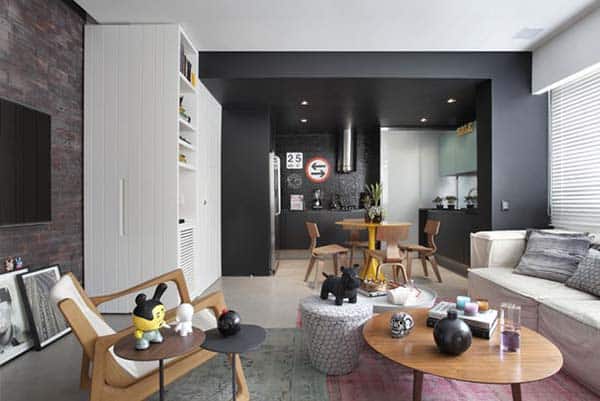
Loft in Itaim was designed by studio FGMF Arquitetos in Sao Paulo, Brazil. The architects’ first priority was the demolition of the walls to create a more free flowing space and to gain further emphasis on the 1,742 square foot (162 square meters) apartment’s greatest asset, the double height ceiling and large windows. In order to gain a feeling of spatiality and organize the books, the studio created a large bookshelf that spans the entire living room, which creates an open and integrated kitchen space and ends in the entrance hall.
The furnishings became the most striking element of this project, creating references of the loft’s entire spatial organization. The project’s covering was subordinated to the bookshelf – the ebonized floor, the white face-brick walls, the ceiling with apparent concrete. The lighting was resolved through a large overhead track that may be regulated as needed and results in direct and indirect lighting.
The works of art collection is exposed on all possible walls and little gems can be found amidst the decor, such as a small Jeff Koons semi-hidden on the acrylic coffee table.
The contemporary furniture, such as the exclusively designed sofa and the Campana brothers’ armchair, is placed with pre-existent antique family furniture. The set forms a place where the family aesthetics transpires and invades the visitor, from its spatiality to little findings placed on the bookshelf.
Photos: Fran Parente
24
Rustic fisherman’s house in the village of Buzios
High on a hill, away from the hype, is this small house in the picturesque fishing village of Buzios, Brazil. The owner, businessman Santiago Bebianno sought out a space that was on high ground, isolated, but close to the village, with the constant breeze and beautiful scenery surrounding. Divided into modules, the construction of the 1,614 square foot (150 square meters) house was carried out by architecture studio Das Canoas. Building was done gradually, respecting the budget and because the client was in no hurry.
When Santiago first moved in, he just had his bedroom and bathroom, the rest of the house was a concrete slab with no electricity. He lived by candlelight for four months, waiting for the installation of cables. The work took place over the course of a year, with labor and local raw materials. Santiago wished for a simple style, a rustic finish and simulating a fisherman’s house. The goal to create relaxing spaces that are open and airy and that everything was easy to use and maintain. Via
3
Praia do Felix Beach House in the Brazilian forest
Since this projects initial conception Praia do Felix Beach House was treated as a “case” to be deployed in areas of high conservation restriction on the slope of the Serra do Mar, Praia do Felix, Brazil. Designed by architecture firm Vidal & Sant’Anna, maximum environmental conditions were preserved utilizing the principle of total mimicry with nature not to be perceived externally.
The project opts for circulations made by external stairs and separates the social and service, located across the slope from intimate area located along the slope below the ground. Very light, the residence, made of certified wood and glass, explores small and minimal rooms to meet the programmatic needs without losing the sense of sustainability.
With three bedrooms, two bathrooms, family and living room, guest bathroom, kitchen, service area and spacious terrace, the house with 1,668 square feet (155 square meters) of built area, is deployed against the contour preserving characteristics of soil and original ground vegetation. With cross ventilation and air chambers on the roofs / decks, environmental comfort is guaranteed without the need for equipment for temperature equilibrium. The rigidity in the form of execution of the work secured the commitment made by the owners in the conservation and preservation of the area. Today the house is prominent among the inhabitants of Praia do Felix although not noticed in the dense forest location.
Photos: Fran Parente
13
Striking multi-level modern dwelling in Sao Paulo
The architectural design of the Mirante do Horto House, situated in Sao Paulo, Brazil, came from a desire to maximize the use of the site while ensuring that all programmatic needs were met. The residence was designed by architecture studio Flavio Castro, in which three small boxes were created on top of each other with an overall living space of 3,229 square feet (300 square meters). All interior spaces in the voluminous structure needed to enjoy flexibility while at the same time having a wide visual range.
According to the architects, “Connecting the house from top to bottom, the right wall next to the staircase inside the house offers vertical connections to the exchange of fluids between the four height levels, while providing space for a different event in each.” There is a garage/utility floor, four feet below street level, the main level with a kitchen, dining, living room with a large aquarium and home theater, the upper level features the bedrooms, studio and office and a stairway leads up to a rooftop terrace offering spectacular city views and a garden that contributes sustainability to the home and helps cool the area below. Via
Photos: Nelson Kon
3
Spacious Brazilian villa with spectacular views
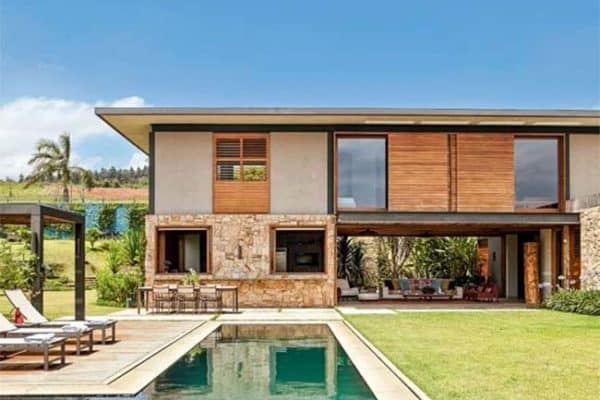
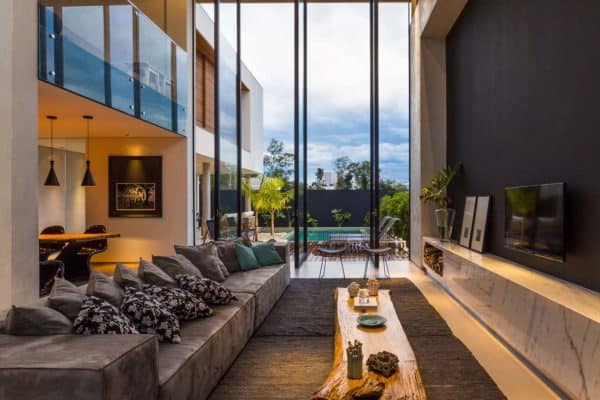
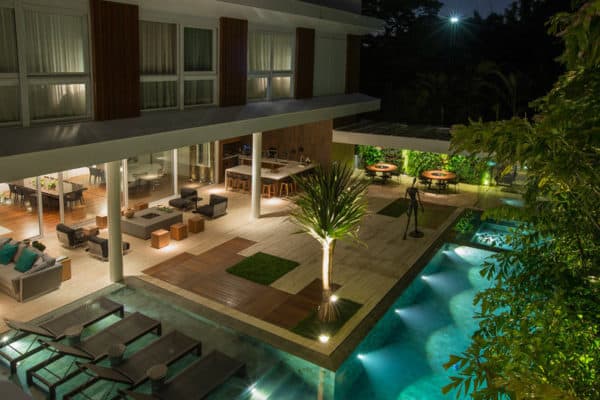
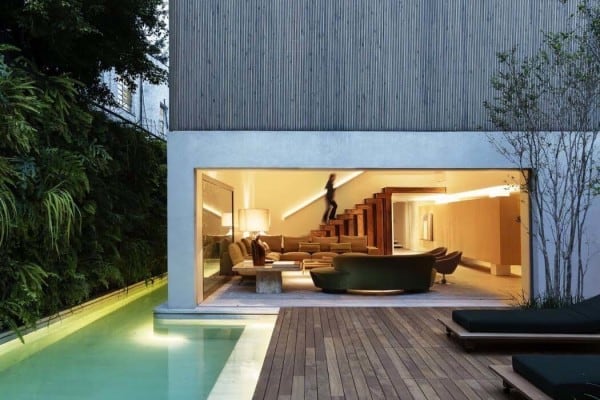
This spacious villa located just out of Sao Paulo in Brazil was designed by architect Candida Tabet. Every room in the house offers an incredible view of the distinct landscape. One on side of the house lies the forest and on the other, the mountains. The form found by the architect was the transformation of the 12,163 square foot (1,130 square meters) home into a continuity of lush surroundings. For this, she has implemented the construction section of the lot where the eye would be able to wonder out to the horizon. The fireplace in the living room adds a unique and artistic focal point to the space. Throughout the home brightness is added through colorful artwork on the floor, walls and furnishings. A spacious balcony extends out to an infinity edge pool whose contours purposely oppose the local geography. The extension of the roof of the house increases natural light and adds to the aesthetics of the facade. Via