





6
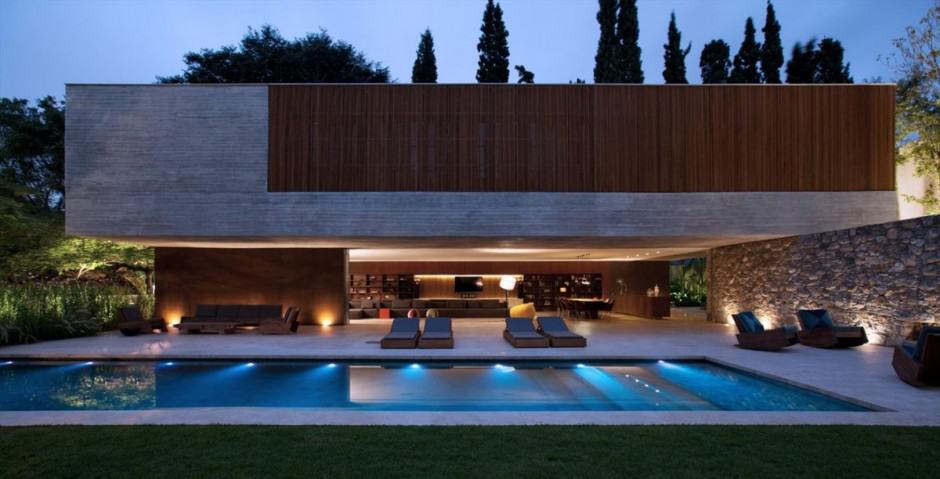
Exposed concrete shelter in Sao Paulo
Ipês House has been designed by Marcio Kogan’s StudioMK27 in São Paulo, Brazil. The home incorporates exposed concrete in a radical manner throughout the upper volume and, as such, the large concrete box appears to be floating atop a glass volume. In the living room, which continues to the veranda and the garden, the doors open entirely, diluting the division between interior and exterior. The main entrance is done through pivoting panels that also open entirely to the front garden. In the internal space, a long irregularly-shaped sofa wriggles around the room, constructing a space with no hierarchy among the different orientations.
On the top floor, a TV room distributes the circulation to the bedrooms, which are lit by a wood block on the concrete wall of the facade. The wooden brises offer the interior great thermal comfort and makes it possible to totally control the lighting.
The structure of the house incorporates large spans which accentuate the Idea of a floating Box, besides propitiating a totally free and continuous space. The use of raw concrete refers to modern buildings, aesthetically and functionally, as in a dialogue with this modern architecture. The House of Ipês, with its grand spans and brute material, transpires a sobriety and the concrete impregnated by the passage of time, exposes the existence of the life of the building. Via
Visit the website of Marcio Kogan’s StudioMK27 here.
Photos: Reinaldo Cóser
23
Bold and colorful design with shipping containers
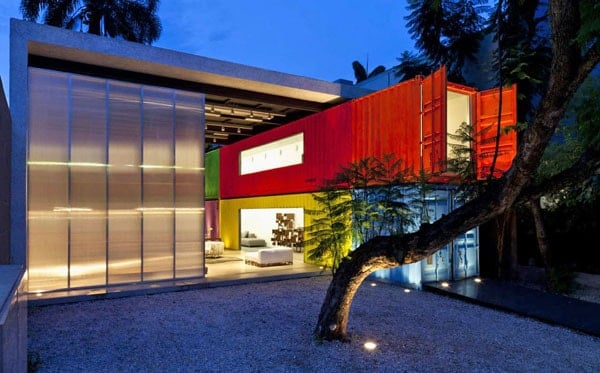
Brazilian architect Marcio Kogan of Studio mk27 has received the world’s best shopping building award from the World Architecture Festival for ‘Decameron’, a retail store in São Paulo, Brazil. The economic solution to a rented site and limited budget, the displays of this shop are placed within two rows of stacked shipping containers which are oriented perpendicular to the main street. The bold and vibrant colors painted on the external surfaces are revealed when a series of large and translucent sliding doors of the metal warehouse structure are unfolded during the store’s hours of operation.
Products are lined along the walls of the narrow hallways, limited by the inherent dimensions of the container units. An arrangement of furniture within the adjoining clear span structure allows visitors to experience the products of the company. Near the rear of the plot, a courtyard garden with planted palm trees and pebble ground cover creates a serene atmosphere to buffer the offices from the common areas. Bound with a glass wall, designers may overlook the activity within the store. At night, the polycarbonate panels glow from the interior showing shadows of people moving within the 2,690 square foot (250 square meters) showroom. Via
Visit the website of Studio mk27 here.
Photos: Pedro Vannucchi
22
The Chimney House in Sao Paulo
The Chimney House has been designed by architects Studio MK27/Marcio Kogan in Sao Paulo, Brazil. A wooden patio with trees, formed by the volumetry of the house and a concrete wall, articulates the entire program of the 4,305 square foot (400 square meters) home. The living room is enclosed in the boxed ground floor of this volume and wide windows open it to the external space. The inner dimensions of the living room 6.5m by 10.3m, and the low ceiling of 2.40m, create a sensation of coziness, accentuated by the textured concrete ceiling made with narrow wooden formwork. In this way, a desired horizontal proportion for this project is created.
In the two-story volume, arranged perpendicular to the living room, on the ground floor, is the kitchen and a family room and, on the second floor, the three bedrooms. Sliding wooden brises filter the light into the inner ambient and the windows open out to the patio. The master bedroom extends outward to a wooden-decked solarium. In this space a ground fire can be used to cook a great barbeque on a sunny day or to light the house on a dark night. The chimneys on the rooftop are of varied shapes, inspired in the chimneys on the rows of houses in the city of Sao Paulo. Via
Visit the website of architects Studio MK27 / Marcio Kogan here.
Photos: Reinaldo Coser + Gabriel Arantes
27
Exceptional open concept home in Brazil
The House 6 project was thought out after the client had made an important request to architect Marcio Kogan. The family wanted a covered external space to be used for everyday living. This space should be used to organize all the social life of the house. The Brazilian tropical climate suggests ample use of these solutions in vernacular as well as in modern architecture. Beginning from the colonial, Brazilian architecture has usually incorporated a space that was known as the veranda. Verandas are covered linear spaces in front of the living room and bedrooms which act as the intermediary between the interior and exterior.
In the House 6 project, the idea of the veranda has been reinvented. The veranda is not exactly in front of the living room, disposed longitudinally, but, rather, perpendicular to it. The wooden pillars that give support to the structure and the clay tiles of traditional verandas have been substituted by modern pilotis that support a volume of flat slabs. The veranda of House 6, nonetheless, still remains an open space and, simultaneously, opens to the garden and the pool. It is a living room, a TV room and an extension of the internal kitchen.
This space, then, structured the entire architecture of the 10,710 square feet (995 square meters) house, organized in two transversal volumes and an annex in the back that holds a home office. The lower volume houses the utilities, the kitchen and the living room with door-frames that can be recessed into the walls, and thereby entirely opening the internal space to either side. This sets the cross-ventilation and an unfettered contiguous view of the garden. The upper volume has the private area of the house with the bedrooms and, on the third floor there is a small multiple-use living room alongside an upper deck. Via
Architecturally, the space of the veranda, located under the bedrooms, would have a low ceiling-height, to create a warm feeling. The sum of the structure of the two perpendicular volumes and the living room ceiling-height would result in a very high ceiling. Thus, it was decided to make the living room lower in relation to the veranda and the garden. This result made it possible to have a house with elongated proportions and the viability of a covered external pleasant space to be used on both warm and cool days in the city of São Paulo.
Photos: Pedro Kok
5
Eco-tropical Brazilian home – Bahia House
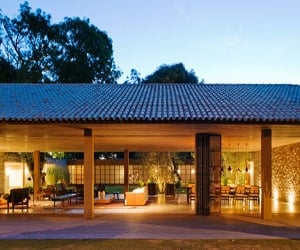
Created by Brazilian architect Marcio Kogan, the home was completed this year in Salvador, Brazil, where the exterior walls consist of sliding latticed wooden panels. The project, called Bahia House, was designed specifically for a hot climate and uses traditional Brazilian building techniques and materials, including clay for the roof and wood for the ceiling. The building is organized around a central patio to maximize natural ventilation and keep the interior cool in hot weather. According to the architect, “The Bahia House is an ecological house. But, not in the technological sense, not in the contemporary sense of the word ‘sustainability’, it does not have the very latest state-of-the-art gadgets that make it possible to optimize electric expenditure.” The openings have large panels of wooden Mashrabiyas that provides vast comfort to the interior. The traditional Bahian house uses the northeastern wind blowing in from the sea to help determine the site plan and has cross ventilation in in the main living spaces of the home to help keep the interior airy and cool.
Photos: Nelson Kon