


10
Bridge House nestled in a forested landscape
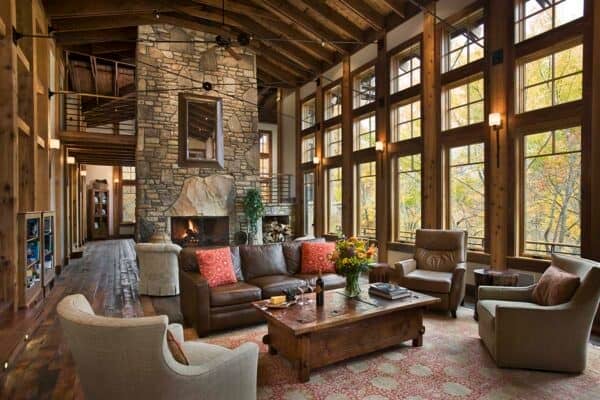
Nestled in a beautiful forested landscape with a creek running below the home in Cashiers, North Carolina, the Knob Creek Residence was designed by Platt Architecture and built by Schmitt Building Contractors. Designed with traditional style interiors, the rustic home features exposed ceiling trusses, high ceilings, wood planked flooring, exquisite light fixtures and many other intricate details. A stunning spiral staircase leads one from the bottom level to the top level on one section of the house. The house is raised up from its foundation, creating a bridge over the rushing creek, where the living spaces have striking views of the surrounding landscape.
Photos: Kevin Meechan
8
Hilltop residence in the Blue Ridge Mountains
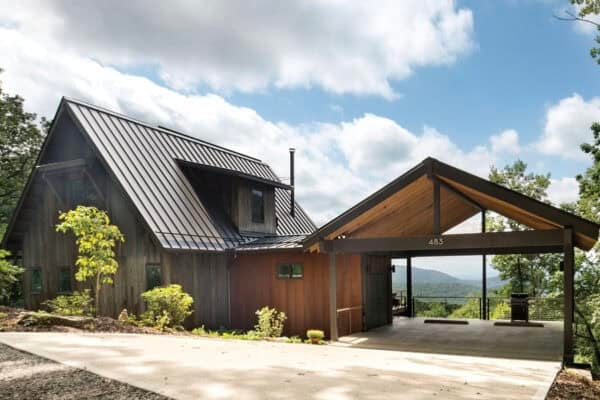
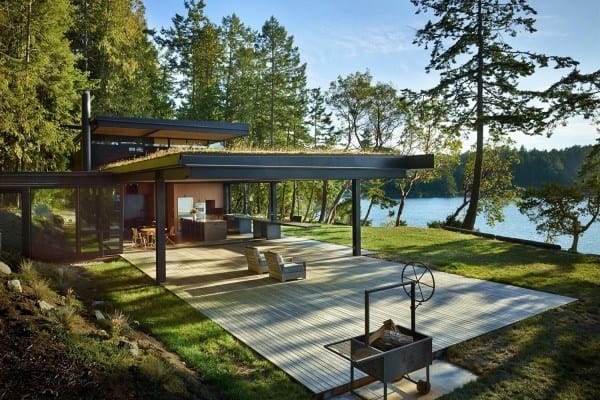
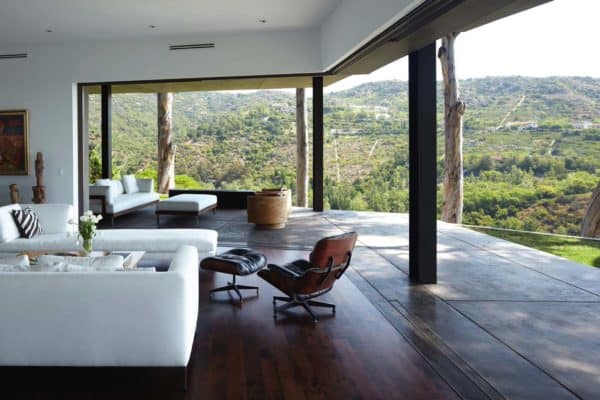
This hilltop residence called ‘Leicester House’ is located at the edge of a wooded knoll in the rolling foothills of the Blue Ridge Mountains of Asheville, North Carolina, with expansive southern and western views. Approaching through dense woods, one arrives at a striking single story facade of corten steel in a wood frame, designed by studio SPG Architects. A hint of the views is provided through the glass door, but it is not until entry that the full impact of the hilltop views can be experienced. The rear glass walls, facing West and South, open to rolling farmland below and the mountains beyond.
The entry level serves as the primary living area, with a guest wing carved into the hilltop on a level below. Functionality and energy efficiency are achieved both by this programmatic zoning as well as the careful choice of materials, fixtures, fittings, and energy. The ‘greening’ of the house complements its visual warmth, grounding the modern structure’s rural landscape.
Photos: Daniel Levin
10
Butterfly house in the forest
This stunning forest home is located on a steep north-facing escarpment 80 feet above Crabtree Creek in Raleigh, North Carolina. Designed by Frank Harmon Architect, the scope of the design was to construct a home that is sensitive to the site by protecting the natural habitat as much as possible. The house was perched off the ground on a series of sono-tube formed concrete piers and wooden trusses allowing minimal site disturbance. The wooden trusses permit air and water to flow under the building, preserving the hydrology of the escarpment. The house was designed with a butterfly-shaped roof to allow views to open out to the north towards the creek and to funnel rainwater into a collection system on the south side. The residence was designed to allow unparalleled views with storefront glass and a steel facade that stretches from the floor to the ceiling. Contrasting the window wall is the solid thick wall to the south. The solid wall never touches the roof allowing the house to have a private face to the street while maintaining views through the clerestory windows towards the forest.
Entrance to the house is a progression from the top of the hill, across a bridge, and into a balcony foyer, at which point the drama of the scenery outside fills the interior through north-facing glass walls.
At all times of the day, the house is filled with a view of nature and, by day, dappled light.
The architect used salvaged steel for an elegant stair that glides along the glass wall, and the home’s owner found sheets of scrap metal to clad the kitchen’s backsplash.
Laminated wood columns and beams strengthen the presence of nature, adding an element of warmth to the interior, echoing the trees beyond.
From outside at night, the house appears as a fragile, luminous tent cradled by the forest.
Photos: Timothy Hursley and Jeffrey Jacobs


Gorgeous renovation of a small apartment in Sweden