


7
Off-grid itHouse takes shelter in the California desert
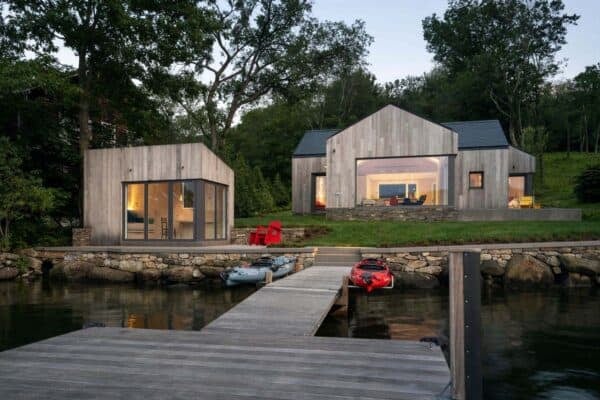
The Off-Grid itHouse is a design system developed by architecture studio Taalman Koch in Pioneertown, California that utilizes a series of components prefabricated off-site to help better control the construction waste, labor, and quality of the finished product. Conceived as a small house with glass walls and open floor plan, the itHouse maximizes the relationship of the occupant to the surrounding landscape while minimizing the building’s impact on delicate site conditions.
Energy efficiency is achieved in the itHouse through passive heating and cooling, utilizing site orientation and cross ventilation, radiant floor heating, hi-efficacy appliances & equipment and the use of solar photovoltaic & thermal panels.
To further enhance the experience of living in a glass house, a graphic design is mapped to discreet areas of the glass walls, creating framed views, sun-shading screen patterns and privacy zones. Artists Sarah Morris and Liam Gillick custom designed the graphic outfit for the off-grid itHouse.
Photos: Gregg Segal
14
Mountain modern prefab blends into surroundings
This prefabricated mountain modern home incorporates touches of heavy timber to blend with its surroundings in Truckee, California. This striking home has been designed by architecture studio sagemodern, with 3,170 square feet of living space, the home was designed to blur the boundary between indoor and outdoor living. The functional floor plan maximizes common areas and bedrooms to accommodate family and friends. There is 1,700 square feet of exterior deck space of Ipe and copper-gray slate tile that is perfect for outdoor functions.
The residence includes five bedrooms and four-and-a-half bathrooms, with a fresh, clean design. With designer fixtures and finishes throughout, the home features sustainably harvested hand scraped hickory and copper-gray slate tiles with radiant heating on the floor. The exterior facade is comprised of hot rolled steel, cedar channel siding and board formed concrete with heavy timber and trellis details. Energy efficient features include thermal insulation of walls, roofs and floors, energy efficient windows, sun protection and bioclimatic architecture and solar water heaters.
13
Attractively designed eco-friendly prefab graces Seattle
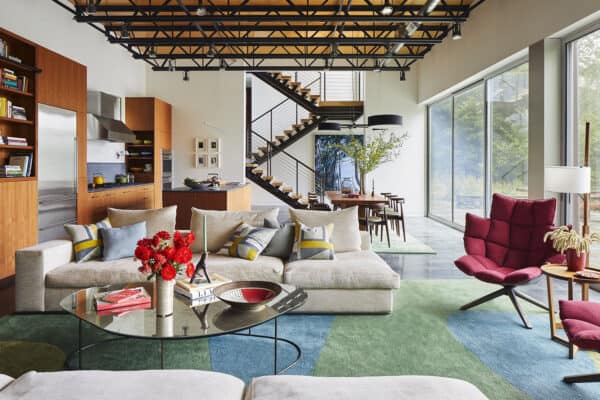
Nestled into a suburban Seattle, Washington neighborhood, this slightly customized prefab house reflects its progressive and environmentally conscious community. The eco-friendly home was designed by West Vancouver-based studio PLACE Architects, with a character that is both friendly and approachable. The homeowners and their two children were downsizing from their 5,000 square foot home to this 2,476 square foot home with the core decision being the idea that we can all live in smaller houses with more outdoor spaces that are preserved for tree growth, play and outdoor activities.
The family has maximized every square inch of the available space in the home. Every functional zone has been clearly defined but offers multiple uses, which meant the home is more efficient and constructed with fewer materials and requiring less expended energy to heat and cool. The cabinetry in the kitchen and living room are formaldehyde free. The residence was assembled onsite from a kit, which took less than seven months to complete. The two car garage is comprised of natural wood shiplap siding and the chartreuse HardiePanel, which are all low-maintenance materials that were carefully detailed to resist the elements gracefully. Above the garage is an office for the homeowner to telecommute part of the week to save time and gas and allow more family time.
With sustainability in mind, all materials in the home are nontoxic and low in volatile organic compounds (VOCs). The home is equipped with low-flow plumbing fixtures to conserve water and with Energy Star-rated appliances. In-floor radiant heating is cost effective, running off the same boiler that supplements the heat for domestic hot water. The flooring is a structural concrete slab, which minimized the layers of material needed to finish out the space, cut down on waste and eliminated a layer of finish that would otherwise have to be replaced every 10 years or so. A solar-powered domestic hot water system heats the backyard lap pool.
Roll-up doors connect the kitchen and dining area to the outdoor patio and pool area.
The dining table, windowsills and stair treads came from a fir tree that was on the property prior to construction.
11
Waterfront property showcasing delicious design elements
The waterfront site of an existing 1970’s kit house overlooks layers of wetlands to an estuary, the bay, and the ocean in Southhampton, New York. Far Pond Residence is a renovation and addition of an existing structure by Bates Masi Architects. The contemporary home was doubled in size to 3,100 square feet utilizing prefabricated elements that resolved multiple structural and spatial problems.
Here is a description of the project from the architects, “Prefabricated shear wall panels, used in light frame construction in areas that are hurricane prone with high force winds, were studied. Most are made from a light gauge metal folded to add strength and rigidity. For our case the panels were to be exposed and used for more than just a hidden structural component. A standard light gauge 4×8 steel sheet was folded back and forth along the long axis adding the same strength and rigidity to the panel. The resulting 2’ panel locks into adjacent panels and is a structural shear and bearing assembly, as well as a decorative furniture component.
The new structural panels multitask throughout the addition. The solid steel transitions to a perforated panel that baffles the sunlight over windows and doors. The light quality varies throughout the day as light levels transition through the overlapped perforations. Fins that protrude from the wall panels are laser cut to accept shelving, seating and countertops. The same perforated steel becomes the dining room chandelier, and the platform for the stair and desk. This one material is exhausted in its possible uses throughout the house, minimizing the necessity for additional components that require wasteful shipping and packaging. The secondary infill material is used through both structures, on the floors, walls and ceilings to unify the old and the new.”
9
Cozy modern mountain retreat in Lake Tahoe
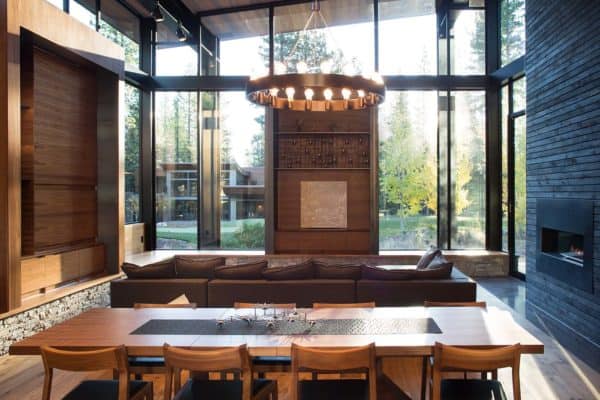
This gorgeous modern mountain home is set amongst the woods in Martis Camp, North Lake Tahoe, completed by design firm sagemodern. The home was designed with significant consideration of the natural setting to blend in with the gradual slope, forest and adjacent putting park. The 3,250 square foot home is used as a family retreat, with a large kitchen and great room for friends and family to gather after a day of skiing or hiking through the forest. The great room features a local quarried stone fireplace, radiant heated Brazilian slate floors, walnut cabinetry and a gourmet professional kitchen. The custom windows and doors framed by exposed timber and steel bring in the natural light to blend the indoor and outdoor living areas. The outdoor area features a spacious deck, a spa area protected by a large boulder outcropping, a fire pit for roasting marshmallows and an outdoor BBQ area. The home was designed for family and guests and has five bedrooms including two master suites, a junior master, a guest room and a bunk room.
All sagemodern homes are created using prefabricated modules in a quality controlled factory environment and then delivered virtually complete to your home site. Their architectural style is rooted in the modern vernacular.
There is no air conditioning in the home, instead there is a heat-recovery ventilation system (above) designed to draw in nighttime air to help keep the home cool.
Japanese kokeshi dolls.
Scandinavian Vedel bird toys.
4
Concrete and glass farmhouse nestled in an orchard
Nestled in a mature apple grove in Sebastopol, Sonoma County, California, the Orchard House is a highly site-specific, cast concrete prefab that has been designed by Anderson Anderson Architecture. This approach allows a high degree of adaptability to the landscape, while keeping construction costs to a minimum. The single-story, 4,500 square foot house is home to a family of four who moved here in 2003 from New York City. They could not leave their city life completely behind, they wanted to adopt elements of their loft into their new home in the countryside. The home needed to be completely accessible to their teenage son who gets around in a wheelchair. They also needed to accommodate two home offices and a study area to homeschool their son. They also desired plenty of space not only for cooking, but for massive kitchen projects such as wine making from their homegrown grapes and oil from their olive trees.
The central living space is open and airy, with a comfortable sitting area on one end and a dining table at the other and it between is a spacious cooking zone. The sleeping areas are set apart from the main room, along a sunlit corridor, which is lined with artworks by various family members. There are two “drive-in” bathrooms that feature open showers with long drains. The material used throughout the farmhouse was concrete. A series of identical C-shaped modules form the structural framework, which sits on a continuous slab foundation. To integrate the house into its surroundings, the wall line up exactly with the rows of trees outside, which are planted on a grid and spaced 25 feet apart. The result is expansive floor-to-ceiling glass doors that span the open alleys between the trees, which create endless views in every direction that tapers into the trunks and leaves.
The concrete extends into the interior spaces, which frames the large kitchen island, with custom niches for appliances and sinks. Accents materials consist of wooden doorframes comprised of reclaimed redwood wine barrels and galvanized steel siding on parts of the exterior. Minimal cabinetry and millwork is manufactured of raw Douglas Fir plywood. At the center of the main living area is a massive slab of salvaged cypress, resting on sawhorses with open shelving underneath. Throughout the interior spaces are open storage areas, no cabinets or drawers so that everything is wheelchair accessible.
The house lies low in a century-old apple orchard, far from neighboring houses. The spaciousness of the rural surroundings is echoed inside.
The wide front door opens onto a wide central living space where the entire family—and a regular cast of visitors—spends much of their time.
The dining room table sits at one end of the main room, with an open view onto the rows of trees that extend out from two sides of the house. A suspended fixture made out of a salvaged branch, crystal pieces, and strung bulbs by the homeowner.
A massive slab of cypress perched atop sawhorses provides storage for pots and utensils.
The cooking area features two islands—one more permanent than the other. A concrete island contains various appliances.
The Andersons designed a system of four-by-four-foot concrete modules, created from a reusable formwork of 2-by-12-foot boards that could be easily moved around the site.
By using the units repeatedly, the architects saved on cost and materials as well as scaling the work to be manageable with one concrete truck and a two-person crew. The resulting facades are textured from the rough wooden planks.
Ben’s office contains an impressive reference library for his inventory of antiquarian books.
An outdoor shower is made from one complete concrete module—a visual demonstration of how the entire house was built.
In the master bedroom, more shelves were installed to accommodate the book collection.
The long hallway leading to the bedrooms gets spectacular afternoon sun, lighting up the family’s many works of art.
In the living room fireplace, a bird turns on the antique French spit.
The outdoor hearth is primed for cooking in the summer.
The open office space is partially secluded thanks to the hanging Algues by Ronan & Erwan Bouroullec for Vitra.
Throughout the house all storage areas are open, leaving crockery, dishware, food, books, and clothes in plain view.
Ben enjoys spending time outdoors on warm days cooking meals for his family.
The oversize hearth (of which there is an outdoor double) was part of the original design specifications. “Ben said he wanted a fireplace big enough to cook a wild boar,” says Mark Anderson of Anderson and Anderson.
Metal buckets of wooden spoons on the counter don’t amount to visual chaos; rather, they’re evidence of a hands-on existence.
The family needed space not just for cooking, which they do a lot of, but for massive kitchen projects like making wine from their homegrown grapes and oil from their olive trees.
Many of the culinary craft projects are an extension of Ben’s work as an artist and dealer of antiquarian books about food and wine.
The material of choice for the loft-cum-farmhouse was concrete, for which the Andersons devised a prefab strategy. A series of identical C-shaped modules from the same formwork compose the structural system, which sits on a continuous slab foundation.
Photos: Anthony Vizzari for Dwell
3
A prefabricated dwelling grips the mountainside
Mount Ninderry is a home that was created by Sparks Architects to explore ideas of sustainable design and living within a modest budget, sited on the ridge of Mount Ninderry in Queensland, Australia. A lineal plan was designed to run along the contours to ease construction on a steep and challenging site. The entry to the building is essentially a hole in a long wall which slides through the landscape. The house is a simple box which ‘hangs’ off the northern side of this wall. The entry forms a breezeway to the house which funnels breezes down the length of the building. It also allows for a separation of the master bedroom from living spaces and other bedrooms, providing privacy in a small home. A self-contained unit and studio makes use of under-croft space that results from a need to excavate the site for rainwater storage.
The building is constructed of 9 prefabricated modules which sit on steel columns. ‘Solarspan’ roofing panels were incorporated to eliminate the need for secondary and tertiary roof framing. Structural glass portholes to the floors of the living area and bathroom allow access to the rainwater tanks. These can be lit up at night with a small reticulation pump providing delicate movements of light to the ceilings. The precast concrete rainwater tanks provide thermal massing with the walls of the tank being incorporated into the studio, en-suite and cellar spaces to the lower floor. A fourth precast tank is utilized as ‘plunge pool’. An array of photovoltaic panels is positioned on the carport roof to service the buildings energy requirements.
Photos: Roger D’Souza
24
Floating house on an island on Lake Huron
This project, designed by MOS Architects, intersects a vernacular house typology with the site-specific conditions of this unique place: an island on Lake Huron in Ontario, Canada. The location on the Great Lakes imposed complexities to the house’s fabrication and construction, as well as its relationship to site. Annual cyclical change related to the change of seasons, compounded with escalating global environmental trends, cause Lake Huron’s water levels to vary drastically from month-to-month, year-to-year. To adapt to this constant, dynamic change, the house floats atop a structure of steel pontoons, allowing it to fluctuate along with the lake.
Locating the house on a remote island posed another set of constraints. Using traditional construction processes would have been prohibitively expensive; the majority of costs would have been applied toward transporting building materials to the remote island. Instead, the architects worked with the contractor to devise a prefabrication and construction process that maximized the use of the unique character of the site.
Construction materials were instead delivered to the contractor’s fabrication shop, located on the lake shore. The steel platform structure with incorporated pontoons was built first and towed to the lake outside the workshop. On the frozen lake, near the shore, the fabricators constructed the house. Via
Visit the website of MOS Architects here.