


7
Off-grid itHouse takes shelter in the California desert
The Off-Grid itHouse is a design system developed by architecture studio Taalman Koch in Pioneertown, California that utilizes a series of components prefabricated off-site to help better control the construction waste, labor, and quality of the finished product. Conceived as a small house with glass walls and open floor plan, the itHouse maximizes the relationship of the occupant to the surrounding landscape while minimizing the building’s impact on delicate site conditions.
Energy efficiency is achieved in the itHouse through passive heating and cooling, utilizing site orientation and cross ventilation, radiant floor heating, hi-efficacy appliances & equipment and the use of solar photovoltaic & thermal panels.
To further enhance the experience of living in a glass house, a graphic design is mapped to discreet areas of the glass walls, creating framed views, sun-shading screen patterns and privacy zones. Artists Sarah Morris and Liam Gillick custom designed the graphic outfit for the off-grid itHouse.
Photos: Gregg Segal
4
Sustainable dwelling nestled on the Kennemer dunes
Villa V is nestled on the edge of the Kennemer dunes, close to Bloemendaal in The Netherlands, designed by i29 interior architects. The sustainable home follows a minimalistic design and shows respect for man and nature alike, in a unique residential area where the existing flora and fauna are given full rein. I29 interior architects worked on the interior of the villa which was designed by Paul de Ruiter architects. A minimal approach to the materialization and detailing of the building is a core value of both the interior and exterior design. The large expanses of glass and the patio result in maximum day-lighting and give the inhabitants the feeling that the villa and the surrounding landscape are one.
In order to bring nature inside even more, all of the interior functions in the house are made from natural materials. i29 interior architects created large surfaces of wood through the whole house to connect the different areas. Cabinets, wardrobes, walls, sliding doors, beds and even a fireplace have been made in one and the same material. Pine wood panels, which are normally a basic material, have been used as a high end finishing with fine details.
Photos: Tim van de Velde
21
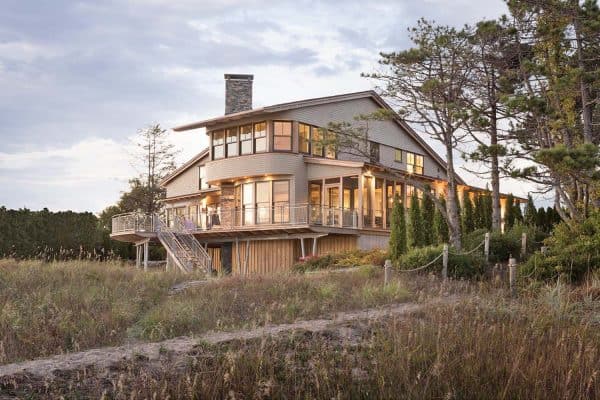
Eco-modern beach house on Cape Cod
This ultra stunning modern beach house has been designed by ZeroEnergy Design to be an environmentally sensible home in beautiful Cape Cod, Massachusetts. The clients are a professional couple, both in different medical fields with a large family including grown children and grandchildren, came to the architects with some unusual space requirements, a narrow lot on an environmentally sensitive site, and a magnificent west-facing view.
They normally reside in downtown Boston, but plan to spend their summers and weekends on the Cape. While their Boston residence accommodates some of their children, their new 6,200 square foot, seven bedroom, eight bathroom beach home will be the only place that will accommodate all seven of them, including their significant others and the grandchildren, thus dictating the need for an extensive number of bedrooms. The entire family will gather over the summer and on holidays, while the couple will use the home by themselves during weekends throughout the year.
Planning for the extreme variation in occupancy was an issue the designers dealt with from the start. The home is split into a ˜Living Bar’ and a ˜Sleeping Bar.’ The Sleeping Bar is the expansion module with numerous bedrooms & bathrooms to accommodate the entire family. The Living Bar includes the living and dining areas, as well as a secondary master bedroom – all that the couple needs when the children are away. This programmatic zoning allows the Sleeping Bar to be shut down during the majority of the year to decrease energy use.
The site has a spectacular west-facing view of the water and sunset. The area of west-facing orientation of the glazing used to capture this view certainly isn’t ideal for energy performance. The narrow lot size, combined with the client’s square footage requirements and the obvious desire to be able to take in the view from the primary living space made the un-ideal orientation of the glazing unavoidable. The rest of the building envelope certainly offsets the luxury view.
The exterior finishes will allow the home to turn a traditional Cape Cod grey and blend into the dunes. The site is vegetated with indigenous plants that prevent erosion and won’t require irrigation.
Choices were also made to promote healthy indoor air quality. Flooring was limited to slate, bamboo, and polished concrete, while omitting any carpeting that might capture dust, mites, mold, or moisture. The rapidly renewable bamboo flooring is bound with nontoxic glues. The insulation in interior walls and floor, used for sound insulation and to improve the performance of the radiant heating system, is formaldehyde-free. An air exchange and energy recovery system will provide clean fresh air throughout the year.
Silvia and Silvia of Osterville built the home with double stud framing which allows a continuous layer of foam insulation (uninterrupted by studs). The geothermal system, coupled with a radiant heating system, will supply all of the heating and cooling for the year. Aside from energy efficient appliances and water heaters, all of the spaces are well illuminated using energy efficient fixtures. The client also decided to minimize the home’s reliance of fossil fuels. Propane is used only for cooking. There is no natural gas.
The roof sports a large solar electric array to offset energy usage through the use of net metering. A battery back-up and energy management system will store electricity from the solar array to ensure the basic functions of the home through blackouts without the use of a gas-powered generator. The combination the energy efficient building envelope and systems with the solar array will allow the home to produce nearly as much energy as it uses over the course of a year!
Photos: Eric Roth
20
Mountain contemporary eco-residence in Park City
2381 Lucky John Residence was designed by The Jaffa Group in Park City, Utah. From day one owner/architect Scott Jaffa wanted to design an innovative energy conscious home that looked toward integrated design and energy solutions. This LEED-certified 5,300 square foot, four bedroom and four-and-a-half bathroom home is truly a mountain contemporary residence blending modern architectural elements with finishes from the surrounding environment. This home is not only tasteful but more importantly, thoughtfully designed with no amenity or ounce of finish work overlooked.
The flat 1.25-acre lot allows for a private front entry court that creates a sense of arrival while the rear courtyard is perfect for private entertaining. This outdoor entertainment area contains a firepit and enormous yard. The exterior hardscaping and landscaping is also an integral part of the overall design. The great room and kitchen are overwhelmingly comfortable and light, which inspire a true sense of “home” — a place to enjoy quality family time or host thoughtful celebrations, with a window wall that brings the outdoors in.
Not only is this home a completely fresh approach to contemporary architecture in Park City, but also strives to be “green.” It uses maintenance-free exterior finishes and self-sufficient utilities. Two solar panel systems were installed to capitalize on the nearly 360 days of sun that Park City receives annually. The first set of panels provides hot water to heat the floors and provide all of the home’s domestic hot water. The second system is 6-kilowatt photo-voltaic array, which brings in enough electricity to power 300, 100-watt light bulbs everyday.
The home has been thoroughly insulated to assist in regulating the homes temperature against the drastic temperature swings of the mountain climate. Insulation was blown into all interior and exterior walls. One and a half inches of rigid foam insulation was attached to the exterior walls with an additional four inches of rigid foam on the roof. A unique drainage plane behind all exterior materials is used to control exterior moisture. Finally, triple-glazed windows, horizontal roofs and steel sunshades offer further protection for the home.
Photos: Courtesy of The Jaffa Group
17
Passive House Retreat off the New England coast
This private retreat and vacation residence was designed by ZeroEnergy Design, nestled in a beautiful community on the New England coast of Boston, Massachusetts. This incredible home features high performance and efficient use of space in a small package. The client sought a 1,200 square foot, two bedroom, two bath home that was right sized for their family – nothing more, nothing less. They also had a goal of minimizing the home’s energy use.
A sleek, simple, gable roofed structure was designed and proposed with the Passive House standard, which is a building performance standard that yields an extremely low-energy home. A combination of exceptional insulation, air sealing, high performance windows, and solar gain reduces the space conditioning requirements to a mere fraction of a typical home, and uses only a very small heating system. The clients, whose extended families owned large, drafty, energy inefficient homes, immediately latched onto the Passive House standard for both the energy savings and the increased comfort. They looked forward to a space with no wintertime drafts and very constant temperature throughout the home.
The gable form the home was planned as the defining aesthetic feature. Its iconic shape and playful red color is carried from the eastern exterior red gable, through to the interior kitchen wall, to the living space, and back outside to the opposite western exterior gable end. Inside, a clean fresh look is achieved with minimal trim, simple polished concrete floors, and careful glazing selection.
The layout was designed around the client’s planned use. The bedrooms are located at either end of the home and receive either morning or afternoon light. The open floor plan of the living and dining space features a dining nook that bumps out of the southern side of the space. Since family and friends often visit, the nook is large enough to sit the family and all their guests. The client also expressed their love of baths. This was addressed by including a dedicated sun-filled tub room in the southeast corner of the home adjacent to the master bath.
Despite the modest footprint, the home addresses all of the client’s needs using efficient space planning, plus features storage space and a loft area above. With a ladder leading up, the loft provides the children with their own private place to spend time away from the adults.
The generous amount of south-facing windows maximize solar heat gain in the winter, using the polished concrete floor to absorb the heat and re-radiate it into the space. The north-facing high performance glass door opens up to the agrarian view out over abutting farm lands, seamlessly connecting the interior living space with the exterior patio.
High R-values in the home and exceptional air sealing mean that only about one-tenth of the energy is needed for heating when compared to the requirements of a conventionally constructed home. In addition to the very small heating system, the house also incorporates a heat recovery ventilator to maintain excellent indoor air quality with minimal energy expense.
Photos: Greg Premru Photography
16
Under Tree House showcasing brightly colored interiors
Situated on a lot with nine mature post oak trees, Under Tree House has been designed by architecture studio Loop Design in Austin, Texas. The architect designed the home for clients that are good friends, which is a big part of why they were hired for the project. They wanted the house to grow from this bond, to be a place that feels particular when you walk through it, because it was conceived with people who know them and love them. They wanted it to feel like home before they even moved in. The home features a modern exterior and a streamlined, brightly-colored interior, which is comprised of only 1,900 square feet, but feels quite spacious due to its outdoor areas like the breezeway, decks, second floor terrace, and courtyard.
The lot had never been developed and was covered with mature post oak trees; nearly every buildable square foot was in a root zone. The architect protected the trees by designing around them—they are as integral to the house as its walls and windows. To minimize root zone compaction, the driveway is short, with the carport set to the front of the lot. The house floats behind on concrete piers with cedar decks that terrace down to the ground. The screened breezeway is a front porch, an entry foyer, and a pleasant place to play cards even on a hot summer night.
The house is thin and uses a pier and beam foundation so as not to disturb the trees—light, air and views of tree and sky reach in from all sides. The approach to sustainability is largely low–tech: build in an existing neighborhood where you plan to stay, keep conditioned spaces small through good connection to outdoor spaces, make the sun and shade work for you, collect the rain, plant a garden. On this shady lot, the garden had to move upstairs, where it is the railing of the roof terrace. It is here, up in the only spot of open sky, your perspective of the site and the house changes—no longer under the tree canopy, you’re up in it.
Before Renovation:
Photos: Whit Preston
14
Striking remodel in Menlo Park: Cloud Street Residence
Cloud Street Residence is a modern single family home in Menlo Park, California designed by Ana Williamson Architect in collaboration with Mediterraneo Design Build. The home has undergone an extensive remodel, completed in 2010. The property is comprised of 1,400 square feet of living space with plenty of environmentally conscious decisions making this “green” house comfortable, including bamboo flooring, Ecowood cabinets, Caesarstone counters, tankless water heater and super high-efficiency HVAC system. The exterior facade is comprised of a smooth Hardie Plank painted in Benjamin Moore Graphite.
4
Sustainable and ecological country house in Segovia
Camouflaged in a dense oak forest in the province of Segovia, Spain, this house is the epitome of sustainable construction, the impulse of a couple who decided to leave Madrid for a life in the county. The owners had a strong desire to escape city life, but not too far away from the city to go as often as they need to. This family home is owned by Tino De la Carrera, a graphic designer who wanted to have a sustainable home and space to be able to work from home. The project has been designed by Garcia German Arquitectos with builder La Colombina.
This is the first housing of a future ecological urbanization which, with homes distinct from one another, will respond to a form of essential life with solar panels, garden, septic and power generation through a simple biomass system that reduces the consumption of electricity and gas up to 70%. The house was constructed in very little time, with prefabricated panels of plywood. Between the house and the ventilated facade there is 7 inches of rock wool insulation: “It’s like a great parka that keeps her warm,” explains De la Carrera. As for the interior, it’s airy and flexible to not obstruct from the views and allows you to modify the distribution at will. If that wasn’t enough, its price is lower than traditional construction.
The layout of the hall between the two large panoramic windows can be seen from this perspective. The porch has a cubic design and a depth that helps protect the interior from direct sun in the summer months.
The living/dining room, from which leads to other rooms, is a splendid view to the landscape.
The home office of the owner of the house, graphic designer Tino De la Carrera, is located on the top floor.
The house, which sits on a brick foundation, boasts flat roofs, thermal insulation and integration into the landscape.
The two floors of the house are heated by the wood Hergom stove.
All the equipment in the kitchen is from Ikea.
The concept of reuse is also transferred to this bedroom: headboard is built and painted tables, a former mannequin serves as a valet and the table comes from a demolition.
Nature sneaks into the bathroom through the window that encloses the shower, clad with stone. A carpenter’s bench has converted into a bathroom vanity cabinet; the mirror, sconces and sink is from IKEA.
Photos: Nuevo Estilo
29
Bent + Sliced Residence in Missouri by Hufft Projects
This is the second take on the originally proposed ‘Bent House’, which was canceled after a design board did not approve the modern style in a conservative neighborhood in Kansas City, Missouri. So the architects, Hufft Projects, decided to take it one step further and now it is the ‘bent and sliced house’. The bend is from the original design (The Bent House), and is a gesture to the curved slope of the site. This curve, coincidentally, is almost the same of the previous design’s site, and thus could be re-utilized. Similar to Japanese Oragami, this 4,197 square foot (390 square meters) house unfolds like a piece of slice paper from the sloped site. The negative space between the slices creates wonderful clerestories for natural light and ventilation.
The Bent and Sliced House also incorporates a number of sustainable features. These include geothermal heat pumps, a vegetated roof in combination with highly reflective and recycled roof membranes, local and recycled materials inside and out, low VOC paints, a cistern to supply all water required for irrigation, and ample daylighting which eliminates the need for artificial light during the day.
The house’s exterior and interior is also marked by the iconic and sensitive use of Western Red Cedar. It wraps the surfaces of walls, encases bathroom furnishings, and turns from the surface of a wall to form a ceiling. The material’s versatility is exhibited to the fullest. Different finishes allow for subtle but noticeable color variations giving the Bent and Sliced House its characteristic signature aesthetic.
Photos: Mike Sinclair
21
Contemporary and sustainable home: Green Cube
This contemporary and sustainable LEED Platinum family show home called ‘Green Cube’ is located in downtown Denver, Colorado. The remodeled home was designed by RE.DZINE, showcasing strong architectural forms, a stunning glass staircase, recyclable 3D wall panels in the loft (from Inhabit®) a wonderful living wall feature dividing living and dining area.
Photos: Jenifer Koskinen- Merritt Design Photo