4
Sustainable dwelling nestled on the Kennemer dunes
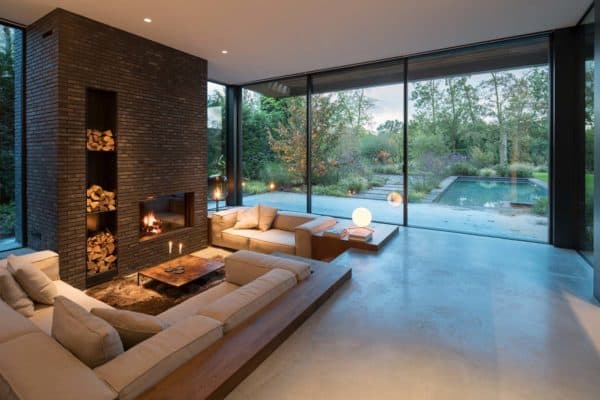
Villa V is nestled on the edge of the Kennemer dunes, close to Bloemendaal in The Netherlands, designed by i29 interior architects. The sustainable home follows a minimalistic design and shows respect for man and nature alike, in a unique residential area where the existing flora and fauna are given full rein. I29 interior architects worked on the interior of the villa which was designed by Paul de Ruiter architects. A minimal approach to the materialization and detailing of the building is a core value of both the interior and exterior design. The large expanses of glass and the patio result in maximum day-lighting and give the inhabitants the feeling that the villa and the surrounding landscape are one.
In order to bring nature inside even more, all of the interior functions in the house are made from natural materials. i29 interior architects created large surfaces of wood through the whole house to connect the different areas. Cabinets, wardrobes, walls, sliding doors, beds and even a fireplace have been made in one and the same material. Pine wood panels, which are normally a basic material, have been used as a high end finishing with fine details.
Photos: Tim van de Velde
28
Joyce & Jeroen House renovation in The Netherlands
Joyce & Jeroen house renovation was an overhaul of a traditional townhouse in The Hague, Netherlands by Dutch studio Personal Architecture. The dilapidated state has necessitated a thorough reinforcement of the foundation and load-bearing structure of the entire house, opening up extraordinary possibilities in an otherwise commonplace apartment renovation. The combination of ambitious design visions and a large measure of trust from the client have resulted in a rigorous and uncompromising redesign, in which voids and split levels accentuate the full height of Den Haag’s typical row houses.
They added mezzanine floors, a glass elevation, a triple-height kitchen and a spiral staircase. Whilst the front half of the house retains its original facade and layout, the architects removed the brickwork garden elevation and replaced it with a steel framework and full-height glass wall, generating an optimal source of daylight. The interplay of voids, the split-levels and the glass facade, all create a spectacular drama between interior and exterior on the one hand, and between the existing and new floors on the other.
The intervention in the back of the house can be interpreted as a three-dimensional, L-shaped element of five storeys, accessed by a new steel spiral staircase. The staircase brings a new dynamic between the different parts of the house and makes a separation between owners and guests possible. Vertically, the L-shaped element ends in a roof-terrace with jacuzzi and outer kitchen that lies far above the balconies of the lower floors.
Small sets of steps connect the four mezzanine levels with the three existing floors of the house, while the original staircases provide a link between floors at the front of the house.
Above the kitchen, a translucent polycarbonate wall lets light into the master bedroom though a walk-in wardrobe positioned at its back.
A wire-fence balustrade creates a balcony on the second floor, so residents can look down from an office to the kitchen below.
Four new mezzanines overlook the kitchen from the side of the house, providing a new bathroom, library and pantry that feature untreated pine walls and floors. A steel staircase spirals up between the levels and leads up to a rooftop terrace and hot tub.
The architects cut away sections of the first and second floors, creating a triple-height kitchen filled with natural light.
Photos: René de Wit
14
Impressive salvaged farmhouse in The Netherlands
This stunning renovated farmhouse is located in Utrecht, Netherlands, designed by interior design firm VIVA VIDA. The farmhouse was quite spacious and the clients wanted it to be designed with salvaged furnishings and materials. They wanted the original atmosphere and function but with any corny interiors. The designers found the perfect match between the original character of the house and contemporary, craft customization, fitting the atmosphere that the clients wanted in the areas and in the way they wanted to live in the house.
“You can spend your time relaxing yourself and you keep surprised and puzzled. All of the spaces are intimate and with its own character. They form entirely original details like the crochet stair parts and (re) use of old materials. The functional design of the kitchen and the special box beds make it personal. Even the wallpaper in our son’s bedroom is made from a photograph of my grandfather as a child around here plays. “
Photos: Courtesy of VIVA VIDA
22
Monumental Coach House breathes new life
A monumental coach house and stable from 1760 has been transformed into a spacious home in Breukelen, Netherlands by Zecc Architects. A mishmash of built curiosities is removed. Historical elements became visible again. The stable, still complete with hay racks and troughs, is used as a living room. The tack room becomes the entrance hall and the coach house the new kitchen. Some over-sized high doors reappeared during the demolition. This created a surprising connection between living room and kitchen. In this high dimension, a new staircase of solid oak wood is placed as a modern addition. It has become the center of the house, and daylight falls from the roof into the new kitchen. A double hood with wooden trusses determines the atmosphere upstairs. A seating arrangement around a wood stove is added as a pleasant lounge. From here the bedrooms and bathrooms are accessible as well.
7
Vertical Loft presents bold architecture in Rotterdam
This so called do-it-yourself dwelling in the center of Rotterdam, The Netherlands is part of a bold experiment initiated by the municipality to revitalize dilapidated urban areas. Run-down pre-war dwellings are renovated on the outside by design studio Shift Architecture Urbanism and brought back to their monumental appearance, while the interiors are stripped bare. The empty shell dwellings are primarily bought by enthusiastic young people who transform them according to their specific needs, desires and budgets. Real estate developers have picked up the initiative and a new demand driven market of urban housing has been generated in recent years. The result is a growing number of contemporary custom-made dream houses within the uniform old fabric of the traditional nineteenth and early twentieth century city.
Here is a description of the project from the architects, “Our dream was to create a vertical loft: a house without walls where all three floors are stitched together into one continuous space. The interior of the new house is organized by one oversized closet that connects all floors. It functions as a storage device for the whole house. This piece of XXL-furniture, measuring 10 meters in length and 9 meters in height, replaces the load bearing middle wall of the original house. Its modular system integrates kitchen appliances, bookshelves, wardrobe, and a walk in closet. The introduction of a central void reinforces the presence of the closet. The void enables diagonal views through the house in which the closet is experienced in its full height. It also makes daylight penetrate far into the 14 meter deep house. Two steel stairs in the void make the bookshelves accessible and create a vertical circulation along and through the closet.”
“The extreme makeover of the house is combined with a selective preservation of elements of the old casco. Industrial materials such as the phenol coated multiplex of the closet and the polyurethane flooring are balanced by the longitudinal brick wall that is left bare, the stained glass and the original doors that are restored and re-used. The roughness of the wall, full with traces of the past, tells stories about the continuous makeovers that the house has undergone in the last hundred years.”
Photos: Rene de Wit & Jeroen Musch
6
Church conversion in The Netherlands: God’s Loftstory
God’s Loftstory is a converted church designed by Dutch studio Leijh Kappelhoff Seckel van den Dobbelsteen architecten, situated in the village of Veldhoven,in The Netherlands.
Here is a description of the project from the architects, “The former Dutch Reformed Evangelism Building in Haarlo has been transformed into a unique loft. The starting point for the design were the retained qualities of the 1928 dating monument, the façade, the bell tower with clock, the volume, the iconic location on the outskirts of the village and nice details like the wooden roof construction, the old panel doors and arch windows with stained glass.
This project demonstrates that a transformation of a church with limited resources is possible, when using a smart design and an efficient plan. The concept was; strip, isolate and furnish. The result represents the motto of the owners: “Cherish your inner child; remain pure, playing, exploring and a little bit naughty!”
“It was a conscious choice, not to fill the volume of 1100 m3 completely with as many rooms as possible, but to minimize the demands, in order to retain the spaciousness of the building. The only architectural additions are the mezzanine for the relaxation room and the multifunctional “Stairway to have fun” (stairs, room divider, closet, build-in-kitchen, acoustic element and exhibition wall).”
“This project shows great passion, humor, respect, love and creativity. This is being reflected in the, specially for this project realized, elements like the swing “swinging sister”, the “KROONluchter” (inspired by the original organ), the “gate of heaven” flanked by a wall of guardian angels, the “stairway to have fun”, the “holy shit” on the toilet, birdhouses with lamp for strange birds that have seen the light and the wooden “lost sheep” in the garden.”
“The modern garden has large plastered planters, made by left-over-bricks. There is an herb garden, a vegetable garden, a flower garden and an orchard; a contemporary nod to the old monastery gardens. The outside shed with a porch is a 40ft container, integrated into the wooden fence and equipped with a green roof. By deepening the garden, a private garden is created yet still a view at the church is remained intact.”
“The materials that were used are pure, sober, functional and budgetary; concrete on the floor, the original wooden floorboards off the church as cladding for the “Stairway to have fun”, stainless steel kitchen elements, a hard glass partition to retain openness, white stucco ( for making the space light inside ) and strategically chosen red accents.”
Photos: Vincent van den Hoven
6
Spacious and transparent dwelling full of light
This single family apartment for four people is situated in a stately building in the town of Rooseveltlaan, southern Amsterdam, Netherlands, designed by i29 l interior architects. The original 1,614 square foot (150 square meters) structure, with rooms for staff, a double hall and long hallways with lots of doors has been transformed into a spacious, transparent dwelling full of light and air.
A kitchen in combination with cabinets from floor to ceiling has laser-cut front panels, all spray painted white. This pattern results in a dynamic mixture of open and closed cabinets, the holes also function as integrated handgrips. The transparency of the object’s skin gives depth to the volume which is complimented by furniture like the Grcic chair one. An atrium with open staircases brings natural light from a large roof light into the living area.
Along the open staircase a wall of two stories high is covered with clear pine wood, and connects the two levels. Upstairs the master bedroom is situated next to a large bathroom with a finish of structured tiles from Patricia Urquola, glass, and wooden cabinets.
Photos: Courtesy of i29 l interior architects
23
Historic railway cottage in The Netherlands
The most recent project from ZW6 Interior is the Railway House in Santpoort, The Netherlands. The former Railway House, built in 1867, is almost brutally shot through with a large Cortensteel volume. On two sides an extension is achieved with hard lines and large glass surfaces, which focuses on the surrounding greenery. The small Railway House literally breaks through its ancient walls outside and provides new insight into landscape. The old railway cottage is on the inside almost unchanged.
The remains of numerous alterations have been removed, leaving a pure and characteristic brick cottage. This old section provides security and simultaneously connects all contiguous open spaces of the house. From the middle of the house you will experience long sightlines and a waterfall staircase connecting the various floors. On the east side a volume is added to the entrance and the living room. In the basement you can find the sleeping area with bathroom. By making the extension narrow and elongated an intimate patio is created on the south side, covered with shells.
On the west side the expansion is oriented in the width. This dining room is linked to the kitchen in the old Railway House. In the Railway House exciting reversals between inside and outside arise. The outside of the house is the interior for the dining room and the patio looks mostly an interior space. Old elements and new additions alternate each other surprisingly. Hard materials meet the gentle atmosphere of the old house. In the interior this variety continues.
Design classics combined with found objects, a Persian carpet on the hard untreated concrete, a surfboard next to the dining table and a series of remarkable plants throughout the Railway House. You also can find an extraordinary art collection which gives every space a special and unique atmosphere.
Photos: Cornbread Works
8
Modern aluminum and glass home in Amsterdam
The sensational Rieteiland House was designed by studio Hans van Heeswijk Architects on a plot of land that is part of a newly established island at IJburg on the outskirts of Amsterdam in the Netherlands. The clients asked for a house that is completely orientated with panoramic views to the park and the landscape. The boxlike street facade is completely cladded with perforated horizontal aluminum panels, of which some can open automatically to make way for the windows behind them. The facade on the waterside is completely made out of glass sheets and sliding doors.
The 2,900 square foot house is an elongated rectangular block of three floors and a basement. Inside, the space literally opens up. Most of the floors have a double height and are open. In this way the house can be seen as a sort of spatial grandstand. By this on every level a panoramic view is created towards the west, the water and the park. Every night from the house magnificent sunsets can be watched. This creates a special holiday like atmosphere.
In the core of the house, a three floors tall service block/tower contains toilets on each floor, storage spaces, installation shafts and a dumbwaiter. Apart from the house also some of the furniture was designed especially for this project. Special attention has been given to sustainability and saving energy. A cold and heat pump, thermal energy storage and solar collectors are used for this purpose.
Visit the website of studio Hans van Heeswijk Architects here.
Photos: Imre Csany/Csany Studio
10
A tropical vacation getaway in the Caribbean
Spectacular views over the Caribbean and breathtaking sunsets can be enjoyed from the terraces and balconies of Villa Kas Dorrie on the island of Bonaire, The Netherlands. This majestic oceanfront villa features a modern kitchen, open air living room with panoramic views of the sea and four bedrooms and four bathrooms and two half baths, one on each floor. The home has been designed by the famous Dutch designer Piet Boon. The natural materials used throughout this house give it a robust and open character. The tropical courtyard garden and magnificent high ‘open’ ceilings make this home very unique. There is also a swimming pool and wooden deck with lounge beds and lounge chairs, two gazebos on the sea and an open air kitchen with fridge, dishwasher, BBQ and grill. Discover a natural haven of luxurious tranquility and stylish relaxation that this perfect getaway has to offer.
This extraordinary vacation rental can be all yours for $12,000 per week from here.